This article is from page 14 of the 2006-09-26 edition of The Clare People. OCR mistakes are to be expected so download the original SWF or the rendered page 14 JPG
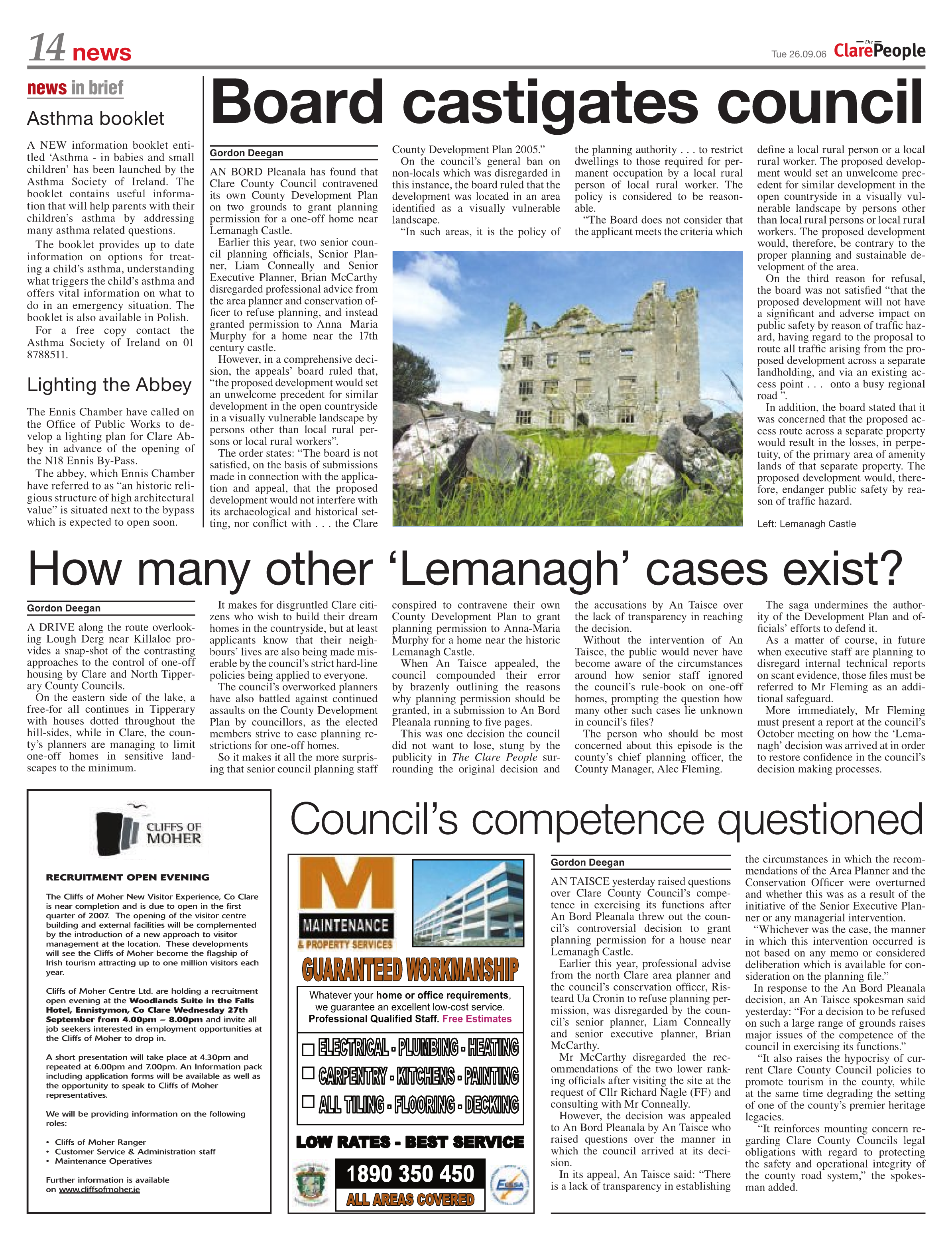
AN BORD Pleanala has found that Clare County Council contravened its own County Development Plan on two grounds to grant planning permission for a one-off home near Lemanagh Castle.
Earlier this year, two senior council planning officials, Senior Planner, Liam Conneally and Senior Executive Planner, Brian McCarthy disregarded professional advice from the area planner and conservation officer to refuse planning, and instead granted permission to Anna Maria Murphy for a home near the 17th century castle.
However, in a comprehensive decision, the appeals’ board ruled that, “the proposed development would set an unwelcome precedent for similar development in the open countryside in a visually vulnerable landscape by persons other than local rural persons or local rural workers”.
The order states: “The board is not satisfied, on the basis of submissions made in connection with the application and appeal, that the proposed development would not interfere with its archaeological and historical setting, nor conflict with . . . the Clare County Development Plan 2005.”
On the council’s general ban on non-locals which was disregarded in this instance, the board ruled that the development was located in an area identified as a visually vulnerable landscape.
“In such areas, it is the policy of the planning authority . . . to restrict dwellings to those required for permanent occupation by a local rural person of local rural worker. The policy is considered to be reasonable.
“The Board does not consider that the applicant meets the criteria which define a local rural person or a local rural worker. The proposed development would set an unwelcome precedent for similar development in the open countryside in a visually vulnerable landscape by persons other than local rural persons or local rural workers. The proposed development would, therefore, be contrary to the proper planning and sustainable development of the area.
On the third reason for refusal, the board was not satisfied “that the proposed development will not have a significant and adverse impact on public safety by reason of traffic hazard, having regard to the proposal to route all traffic arising from the proposed development across a separate landholding, and via an existing access point . . . onto a busy regional road ”.
In addition, the board stated that it was concerned that the proposed access route across a separate property would result in the losses, in perpetuity, of the primary area of amenity lands of that separate property. The proposed development would, therefore, endanger public safety by reason of traffic hazard.