This article is from page 10 of the 2006-02-28 edition of The Clare People. OCR mistakes are to be expected so download the original SWF or the rendered page 10 JPG
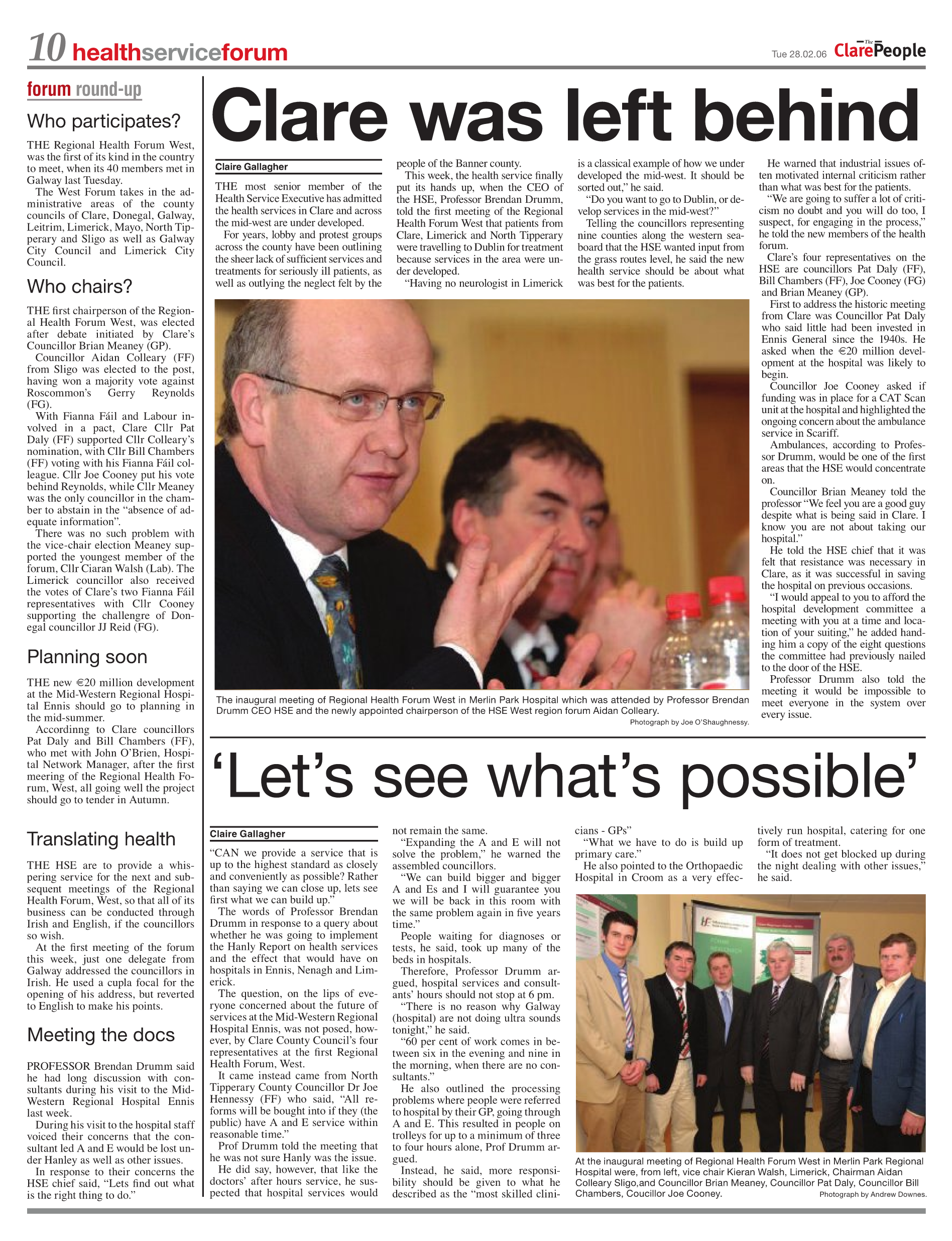
“CAN we provide a service that is up to the highest standard as closely and conveniently as possible? Rather than saying we can close up, lets see first what we can build up.”
The words of Professor Brendan Drumm in response to a query about whether he was going to implement the Hanly Report on health services and the effect that would have on hospitals in Ennis, Nenagh and Limerick.
The question, on the lips of everyone concerned about the future of services at the Mid-Western Regional Hospital Ennis, was not posed, however, by Clare County Council’s four representatives at the first Regional Health Forum, West.
It came instead came from North Tipperary County Councillor Dr Joe Hennessy (FF) who said, “All reforms will be bought into if they (the public) have A and E service within reasonable time.”
Prof Drumm told the meeting that he was not sure Hanly was the issue.
He did say, however, that like the doctors’ after hours service, he suspected that hospital services would not remain the same.
“Expanding the A and E will not solve the problem,” he warned the assembled councillors.
“We can build bigger and bigger A and Es and I will guarantee you we will be back in this room with the same problem again in five years time.”
People waiting for diagnoses or tests, he said, took up many of the beds in hospitals.
Therefore, Professor Drumm argued, hospital services and consultants’ hours should not stop at 6 pm.
“There is no reason why Galway (hospital) are not doing ultra sounds tonight,” he said.
“60 per cent of work comes in between six in the evening and nine in the morning, when there are no consultants.”
He also outlined the processing problems where people were referred to hospital by their GP, going through A and E. This resulted in people on trolleys for up to a minimum of three to four hours alone, Prof Drumm argued.
Instead, he said, more responsibility should be given to what he described as the “most skilled clinicians – GPs”
“What we have to do is build up primary care.”
He also pointed to the Orthopaedic Hospital in Croom as a very effectively run hospital, catering for one form of treatment.
“It does not get blocked up during the night dealing with other issues,” he said.