This article is from page 4 of the 2006-11-28 edition of The Clare People. OCR mistakes are to be expected so download the original SWF or the rendered page 4 JPG
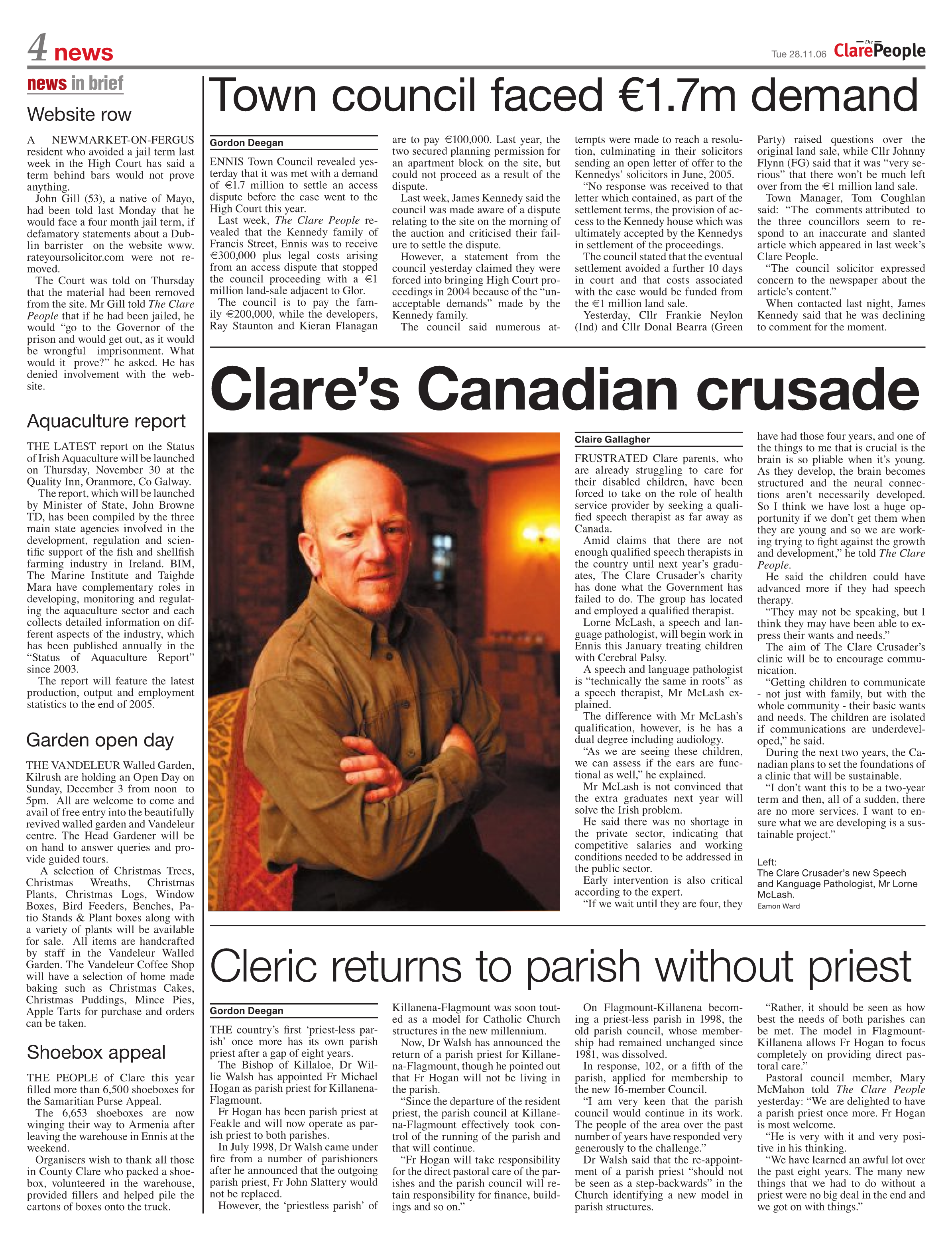
FRUSTRATED Clare parents, who are already struggling to care for their disabled children, have been forced to take on the role of health service provider by seeking a qualified speech therapist as far away as Canada.
Amid claims that there are not enough qualified speech therapists in the country until next year’s graduates, The Clare Crusader’s charity has done what the Government has failed to do. The group has located and employed a qualified therapist.
Lorne McLash, a speech and language pathologist, will begin work in Ennis this January treating children with Cerebral Palsy.
A speech and language pathologist is “technically the same in roots” as a speech therapist, Mr McLash explained.
The difference with Mr McLash’s qualification, however, is he has a dual degree including audiology.
“As we are seeing these children, we can assess if the ears are functional as well,” he explained.
Mr McLash is not convinced that the extra graduates next year will solve the Irish problem.
He said there was no shortage in the private sector, indicating that competitive salaries and working conditions needed to be addressed in the public sector.
Early intervention is also critical according to the expert.
“If we wait until they are four, they have had those four years, and one of the things to me that is crucial is the brain is so pliable when it’s young. As they develop, the brain becomes structured and the neural connections aren’t necessarily developed. So I think we have lost a huge opportunity if we don’t get them when they are young and so we are working trying to fight against the growth and development,” he told The Clare People .
He said the children could have advanced more if they had speech therapy.
“They may not be speaking, but I think they may have been able to express their wants and needs.”
The aim of The Clare Crusader’s clinic will be to encourage communication.
“Getting children to communicate – not just with family, but with the whole community – their basic wants and needs. The children are isolated if communications are underdeveloped,” he said.
During the next two years, the Canadian plans to set the foundations of a clinic that will be sustainable.
“I don’t want this to be a two-year term and then, all of a sudden, there are no more services. I want to ensure what we are developing is a sustainable project.”