This article is from page 19 of the 2006-01-31 edition of The Clare People. OCR mistakes are to be expected so download the original SWF or the rendered page 19 JPG
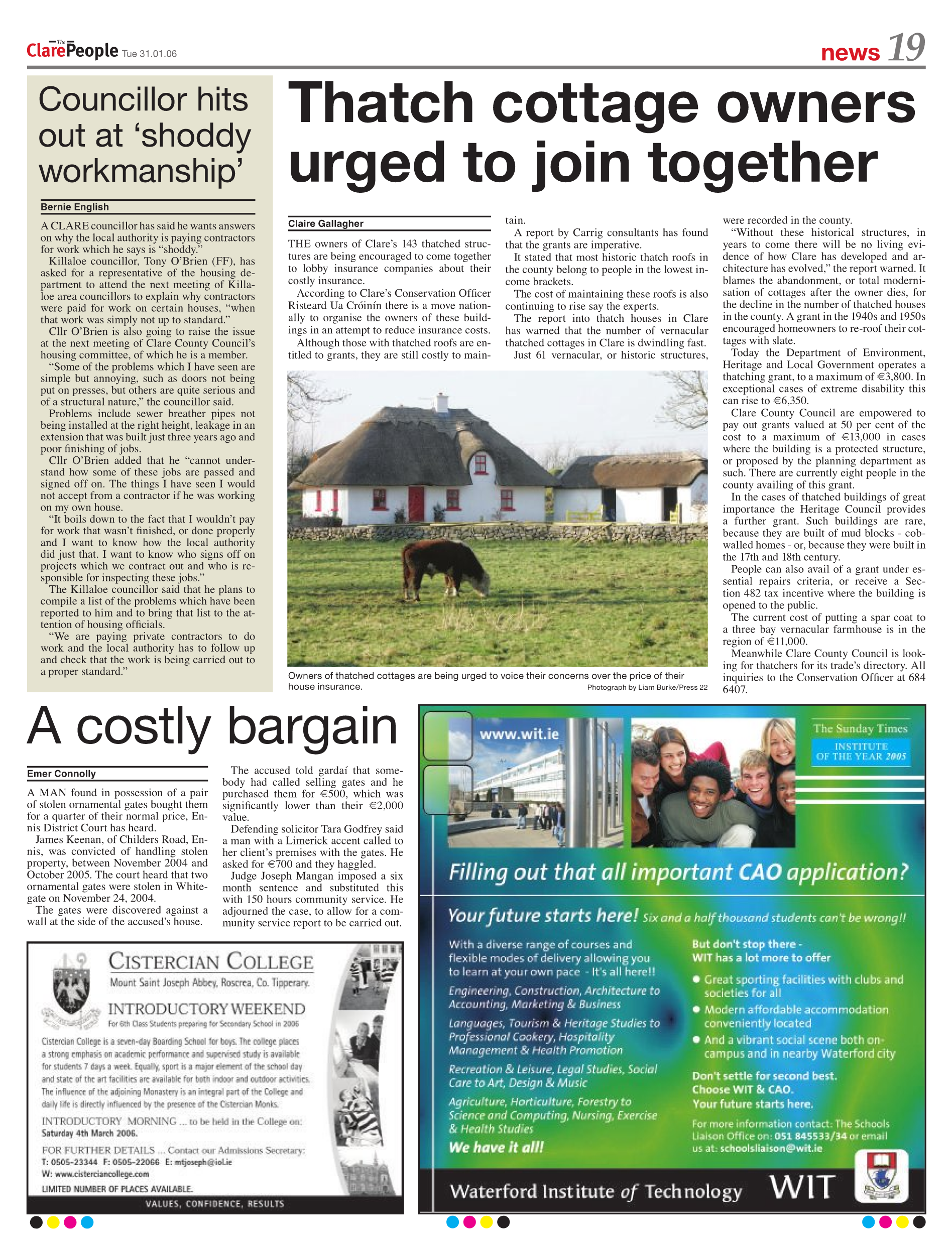
THE owners of Clare’s 143 thatched structures are being encouraged to come together to lobby insurance companies about their costly insurance.
According to Clare’s Conservation Officer Risteard Ua Cróinín there is a move nationally to organise the owners of these buildings in an attempt to reduce insurance costs.
Although those with thatched roofs are entitled to grants, they are still costly to maintain.
A report by Carrig consultants has found that the grants are imperative.
It stated that most historic thatch roofs in the county belong to people in the lowest income brackets.
The cost of maintaining these roofs is also continuing to rise say the experts.
The report into thatch houses in Clare has warned that the number of vernacular thatched cottages in Clare is dwindling fast.
Just 61 vernacular, or historic structures, were recorded in the county.
“Without these historical structures, in years to come there will be no living evidence of how Clare has developed and architecture has evolved,” the report warned. It blames the abandonment, or total modernisation of cottages after the owner dies, for the decline in the number of thatched houses in the county. A grant in the 1940s and 1950s encouraged homeowners to re-roof their cottages with slate.
Today the Department of Environment, Heritage and Local Government operates a thatching grant, to a maximum of €3,800. In exceptional cases of extreme disability this can rise to €6,350.
Clare County Council are empowered to pay out grants valued at 50 per cent of the cost to a maximum of €13,000 in cases where the building is a protected structure, or proposed by the planning department as such. There are currently eight people in the county availing of this grant.
In the cases of thatched buildings of great importance the Heritage Council provides a further grant. Such buildings are rare, because they are built of mud blocks – cobwalled homes – or, because they were built in the 17th and 18th century.
People can also avail of a grant under essential repairs criteria, or receive a Section 482 tax incentive where the building is opened to the public.
The current cost of putting a spar coat to a three bay vernacular farmhouse is in the region of €11,000.
Meanwhile Clare County Council is looking for thatchers for its trade’s directory. All inquiries to the Conservation Officer at 684 6407.