This article is from page 6 of the 2006-05-02 edition of The Clare People. OCR mistakes are to be expected so download the original SWF or the rendered page 6 JPG
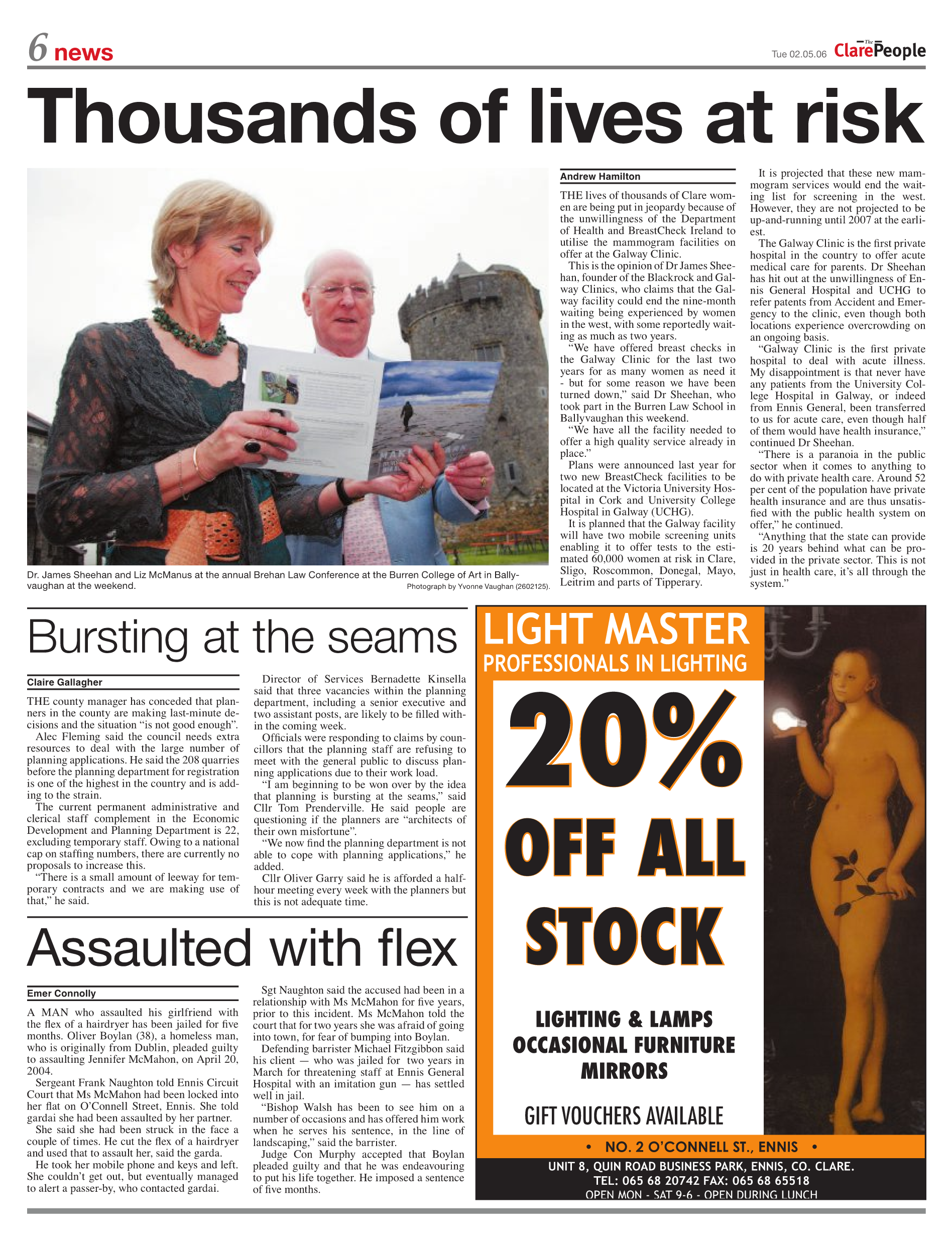
THE lives of thousands of Clare women are being put in jeopardy because of the unwillingness of the Department of Health and BreastCheck Ireland to utilise the mammogram facilities on offer at the Galway Clinic.
This is the opinion of Dr James Sheehan, founder of the Blackrock and Galway Clinics, who claims that the Galway facility could end the nine-month waiting being experienced by women in the west, with some reportedly waiting as much as two years.
“We have offered breast checks in the Galway Clinic for the last two years for as many women as need it – but for some reason we have been turned down,” said Dr Sheehan, who took part in the Burren Law School in Ballyvaughan this weekend.
“We have all the facility needed to offer a high quality service already in place.”
Plans were announced last year for two new BreastCheck facilities to be located at the Victoria University Hospital in Cork and University College Hospital in Galway (UCHG).
It is planned that the Galway facility will have two mobile screening units enabling it to offer tests to the estimated 60,000 women at risk in Clare, Sligo, Roscommon, Donegal, Mayo, Leitrim and parts of Tipperary.
It is projected that these new mammogram services would end the waiting list for screening in the west. However, they are not projected to be up-and-running until 2007 at the earliest.
The Galway Clinic is the first private hospital in the country to offer acute medical care for parents. Dr Sheehan has hit out at the unwillingness of Ennis General Hospital and UCHG to refer patents from Accident and Emergency to the clinic, even though both locations experience overcrowding on an ongoing basis.
“Galway Clinic is the first private hospital to deal with acute illness. My disappointment is that never have any patients from the University College Hospital in Galway, or indeed from Ennis General, been transferred to us for acute care, even though half of them would have health insurance,” continued Dr Sheehan.
“There is a paranoia in the public sector when it comes to anything to do with private health care. Around 52 per cent of the population have private health insurance and are thus unsatisfied with the public health system on offer,” he continued.
“Anything that the state can provide is 20 years behind what can be provided in the private sector. This is not just in health care, it’s all through the system.”