This article is from page 5 of the 2006-06-06 edition of The Clare People. OCR mistakes are to be expected so download the original SWF or the rendered page 5 JPG
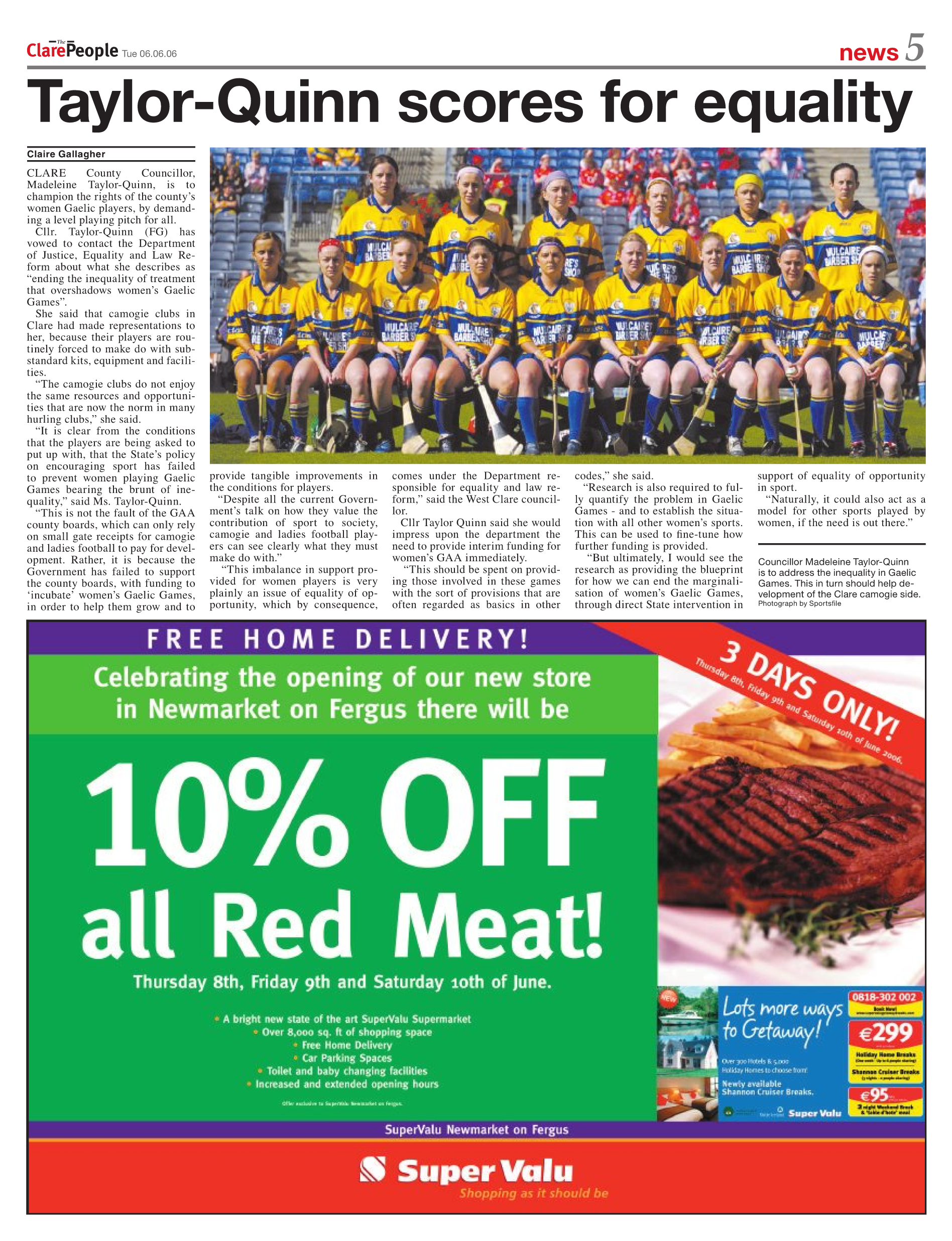
CLARE County Councillor, Madeleine Taylor-Quinn, is to champion the rights of the county’s women Gaelic players, by demanding a level playing pitch for all.
Cllr. Taylor-Quinn (FG) has vowed to contact the Department of Justice, Equality and Law Reform about what she describes as “ending the inequality of treatment that overshadows women’s Gaelic Games”.
She said that camogie clubs in Clare had made representations to her, because their players are routinely forced to make do with substandard kits, equipment and facilities.
“The camogie clubs do not enjoy the same resources and opportunities that are now the norm in many hurling clubs,” she said.
“It is clear from the conditions that the players are being asked to put up with, that the State’s policy on encouraging sport has failed to prevent women playing Gaelic Games bearing the brunt of inequality,” said Ms. Taylor-Quinn.
“This is not the fault of the GAA county boards, which can only rely on small gate receipts for camogie and ladies football to pay for development. Rather, it is because the Government has failed to support the county boards, with funding to ‘incubate’ women’s Gaelic Games, in order to help them grow and to provide tangible improvements in the conditions for players.
“Despite all the current Government’s talk on how they value the contribution of sport to society, camogie and ladies football players can see clearly what they must make do with.”
“This imbalance in support provided for women players is very plainly an issue of equality of opportunity, which by consequence, comes under the Department responsible for equality and law reform,” said the West Clare councillor.
Cllr Taylor Quinn said she would impress upon the department the need to provide interim funding for women’s GAA immediately.
“This should be spent on providing those involved in these games with the sort of provisions that are often regarded as basics in other codes,” she said.
“Research is also required to fully quantify the problem in Gaelic Games – and to establish the situation with all other women’s sports. This can be used to fine-tune how further funding is provided.
“But ultimately, I would see the research as providing the blueprint for how we can end the marginalisation of women’s Gaelic Games, through direct State intervention in support of equality of opportunity in sport.
“Naturally, it could also act as a model for other sports played by women, if the need is out there.”